The City of Bisbee Arizona
(population 6,100) operates 3 wastewater treatment plants. The Warren plant consists of a series of three facultative oxidation ponds that treat approximately
170,000 gallons of primary wastewater per day. The lagoons were put into service
in the early 1960’s and over the years unacceptable levels of bottom solids had accumulated in Lagoon 1. Reduced hydraulic retention time had impacted pollutant removal and created nuisance odors to the degree
that the Arizona Department of Environmental Quality (AQMD) issued a consent order to the City.
Gannet Fleming, the City’s engineering consultant, provided the City
with options necessary to meet the consent order. The first two options explored
were to remove lagoon solids by either draining or physically removing the sludge or through dredging. In either case, the sludge would have to be dried to a degree that solids would meet the paint filter test
and then hauled to the nearest landfill for disposal. Besides the cost associated with physical removal of solids, Lagoon 1 would have to be taken off-line and
the 170,000 gallons of primary wastewater sent directly to Lagoon 2 and Lagoon 3 further overloading an already impaired treatment
system.
Gannet Fleming proposed
a third option which was to reduce solids to the degree that the terms of the consent order could be met while allowing Lagoon
1 to remain in service. The process chosen was to reduce sludge levels
through a bioremediation process. Ennix
Incorporated was chosen to provide proprietary bioaugmentation products and services.
Baseline data was accumulated
to determine sludge levels as well as the levels of Total Solids (TS) and Volatile Solids (VS) in both Lagoon #1 and #2. From February 2003 to August 2003 Ennix fed a custom blend of facultative microorganisms,
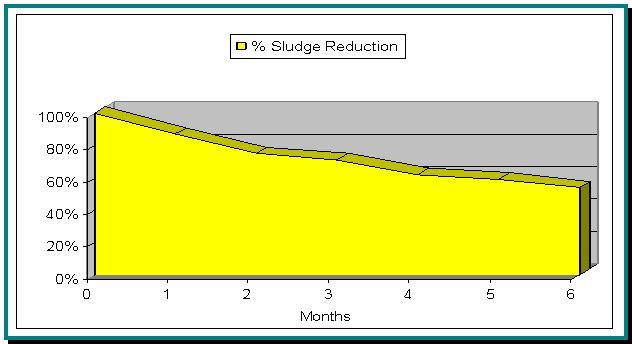
growth enhancing proteins and target enzymes into Lagoon #1 through an automated feeder in the influent line. At the conclusion of the six month project, the results were a
46% reduction of sludge volume in Lagoon 1 and a 22% reduction of sludge volume in Lagoon 2.
A total of 6,562 Cubic Yards of bottom sludge had been converted to carbon dioxide, water and cellular material. Other benefits noted during the project were odor control, an improvement in water
clarity as well as improved pollutant removal. No mechanical or operational changes
were required during the project. The project was completed for $45,000 as
opposed to the estimated cost of $325,000 to physically remove, dewater and haul the solids to landfill.